


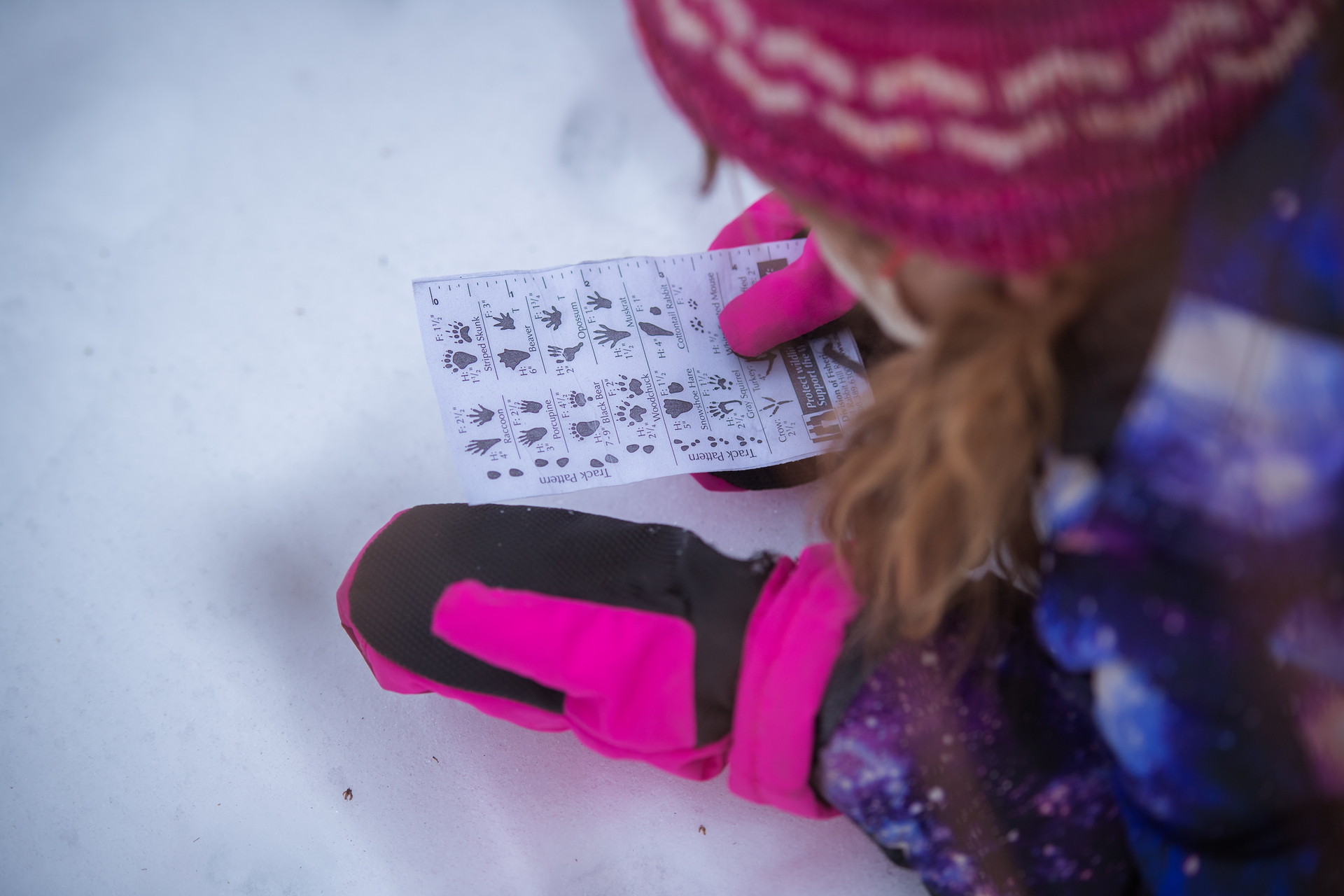
Wildlife Tracking in Winter
Curious about the critters that leave "footprints" on snow-covered yards and fields? Our naturalists can help you solve the mystery!
At one time, being able to read animal tracks was vital for survival. Today, identifying signs of wildlife can teach us a lot about the animals that live in our area.
More often than not, the tracks that you find will not be perfect or complete footprints. They might be partial prints or smudged and difficult to see. But you can use more than just the footprint to learn about the animal.
Here are some tips to help you follow the clues...
Look For Patterns
If you can find more than one track, you should be able to determine a lot about the animal using something called “pattern classification.” Measure the length and straddle (the distance between right and left sides) of the stride to get an approximate size of the animal and a sense for the speed at which it was moving.
Look for the overall pattern of an animal’s tracks to help you figure out whether the animal is a stepper (like deer and canines), bounder (like weasels and mink), hopper (like squirrels and cottontails), or loper (like skunks).
- If you see a straight, narrow trail—where each hind foot lands nearly in the spot of the front foot—you may be looking at a “stepper” or “loper.” This pattern is typical of hoofed animals like deer (or larger mammals like moose), as well as canines or felines.
- If you see sets of four prints grouped together—two small front prints followed by two larger prints ahead—that shape often indicates a “hopper,” such as a rabbit or squirrel. The hind feet land ahead of the front feet as the animal bounds through snow.
- For “bounders”—members of the weasel family (mink, ermine/weasel, otter, fisher)—you might see a pair of prints: the front paws land, and then the rear paws land directly on or very near the same spot, leaving side-by-side rear-print impressions.
In open fields, look for the wing imprints of hawks and owls in the snow, which these birds leave behind when they swoop in to capture prey.
Focus on Details
If you have a nice, clear track, you can measure the width, count the number of toes, look for toenail impressions, and search for hair left behind in the track. In addition to width, you can also use the depth of the track to estimate the size and weight of an animal.
For hoofed animals like deer, look for two-toed, heart- or teardrop-shaped hoof prints. Deer tracks in Massachusetts are typically 2½–3 inches long.
Canine or feline prints—such as from foxes or coyotes—commonly show four toes and a pad, often with claw marks visible. The size, toe spread, and presence of claw vs no-claw marks help distinguish between, for instance, a domestic dog, coyote, or fox. Wild canines often “direct register” (hind foot lands in front footprint), making a straight‐line trail.
For small mammals like rabbits, squirrels, their bounding prints often reveal very small front foot marks and larger hind-foot prints often placed side-by-side as they leap. If you find these, you can often trace their path back to a shrub, tree, or other cover where they might be foraging or hiding.
MassWildlife has an excellent Pocket Guide to Track Animals for reference and graphics.
Don't Forget to Look Up
There’s more to tracking than prints on the ground. Knowing your surroundings will help you better understand what the animal was doing as it moved through the landscape. Are you around conifers or hardwoods, or in shrubland or meadow? Can you spot evidence of where an animal was snacking on a shrub or stalking prey in a field? Was it walking casually or running from a predator? Did it leave behind any scat (droppings) or regurgitated food pellets that might reveal its recent diet?
Keep Your Distance
When tracking animals, it’s important to remember that winter is a difficult time for many wildlife species. Energy conservation is crucial because food resources are limited. It’s best not to track animals back to their dens or bedding sites in hopes of a closer look—try tracking in the direction the animal came from instead. Or simply enjoy the stories left by their tracks, without causing them to expend any undue energy.
How to Start Tracking
Now that you know the basics, you can start tracking today! Check out our tracking guides for sale at the Mass Audubon Shop or join a local tracking program to learn from the experts at Mass Audubon—there's no better way to learn than in the field!
Stay Connected
Don't miss a beat on all the ways you can get outdoors, celebrate nature, and get involved.