


Butterfly Atlas
Find a Butterfly
Long Dash
Polites mystic
Named
Edwards, 1863
Identification
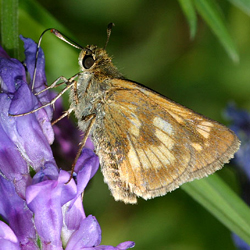
Wingspan: 1-1 and 1/4". A medium sized orange-yellow skipper that may be confused with Indian Skipper (Hesperia sassacus); see discussion under Indian Skipper, "Identification". In male Long Dash skippers the dark stigma connects with or is adjacent to another dark mark forming a line (a "long dash") extending to, or nearly to, the border of the upper forewing. In females there is also an extensive dark slash on the forewing above. Both sexes display a crescent of yellow spots on the hindwing below as well as a single yellow spot near the base of the wing. Because the under hindwing ground color is variable the crescent and spot marking may be more or less obvious. In those individuals having a rust-colored underwing surface the corresponding crescent and spot pattern stands in high contrast and is readily observable; in others with a lighter underwing ground the crescent and spot pattern may be less defined.
Distribution
Across central and southern Canada from British Columbia to the Maritimes and from the Pacific Northwest east through the central Rocky Mountains to New Jersey; also southward along the Appalachians into southwestern Virginia. Scudder (1889) states that "In New England it occurs everywhere . . .but it is much less common in the southern than in the northern half . . ." Opler (1992) gives the skipper‘s range as throughout New England.
Status in Massachusetts
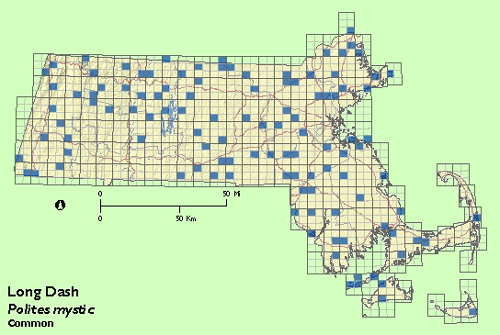
Nearly a century ago Scudder referred to this species as one of our more common skippers noting "There is hardly a local collection of any size which does not contain it . . ." Still a common species, Long Dash was found across the state during the Atlas period from the western most borders eastward to Cape Ann and Cape Cod and the Islands. Interestingly, Scudder also reported that it was rare around Boston and a lack of Atlas records for this metropolitan district may reflect a similar situation. During the peak of its flight period it is not unusual to find a half dozen or more Long Dash skippers in the proper habitat. Maximum: c. 50 on 11 June 1987, Sturbridge (Worcester Co.), B. Cassie.
Flight Period in Massachusetts
Two flights: early June to early July and August. Extreme dates for first flight: 1 June 1986, Granby (Hampshire Co.), N. Weiss and 15 July 1990, Naushon Is. (Barnstable Co.) D. Gregg. Opler (1984) notes that this butterfly is single brooded over much of its range with the a second brood occurring coastally in New York and New Jersey. Although most records are from the June-July flight, a second, smaller flight also occurs here in August, as 4 on 20 August 1986, Millis (Norfolk Co.), B. Cassie.
Larval Food Plants
Blue grass (Poa) is the hostplant species reported by most authorities although several suggest that other grasses may be used.
Adult Food sources
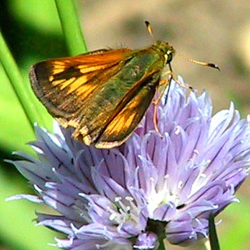
Found nectaring on 16 species of flowering plants by atlas workers including Common Milkweed, Ox-Eye Daisy, and Cow Vetch.
Habitat
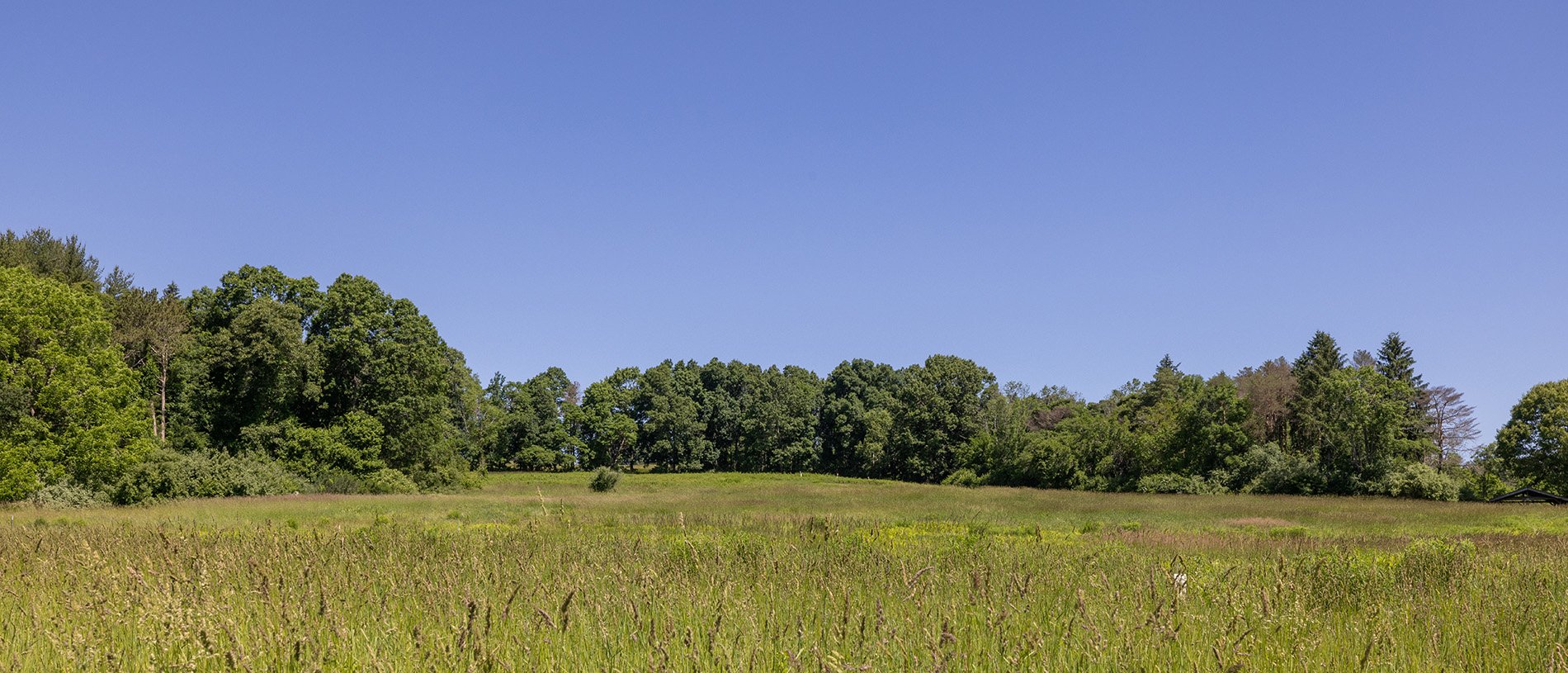
A variety of open and wet locales including wet meadows and fields, marshy edges, and streamsides.
Life Cycle
EGG: Pale green; dome-shaped. OVIPOSITION: Eggs laid singly. LARVA: Brown, mottled with whitish markings; head is black. CHRYSALIS: Black or brown with whitish hairs. OVERWINTERING STAGE: larva after the second or third molt.
Account Author
Richard K. Walton