
| Reptiles and Amphibians | Vernal Pools
What are vernal pools?
Vernal pools are shallow ponds subject to large seasonal water fluctuations. During the winter and spring, they fill with snow, rain, and seasonally high groundwater, but they typically are dry during most of the summer and fall. These areas are important for wildlife including amphibians, invertebrates, and turtles. They are devoid of fish. Vernal pools are found in woodlands, meadows, floodplains, and even sandplains all across Massachusetts. They occur in a wide variety of settings including swales, kettle holes, old stream channels, and depressions in larger wetlands.
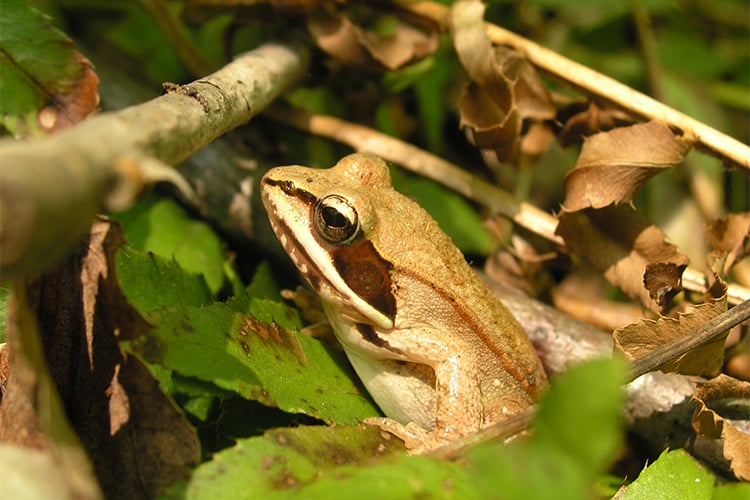
Vernal pools provide unique habitat to specialized species. Some animals live in vernal pools year-round, and so must be able to withstand a wide range of conditions - from saturated with water to bone-dry or frozen. Fairy shrimp can complete their entire life cycle within a few weeks in the pool, surviving dry periods as eggs. Some animals rely on vernal pools for breeding. Frog tadpoles and salamander larvae develop in the pools before migrating to adjacent uplands to live out their adult lives. Several state-listed rare species, including marbled, blue-spotted, and Jefferson salamanders, depend on vernal pools for successful reproduction. These species cannot reproduce in larger, permanent ponds where fish would eat their young. Many vernal pool species, such as wood frogs and most mole salamanders, breed in the spring. Others, such as marbled salamanders and caddisflies, lay their eggs in the dry bottoms of vernal pools in the fall. Their eggs hatch when the pool fills.
Vernal pools are extremely vulnerable to development. Vernal pools are often overlooked when wetlands are identified on development sites because in many months these areas are dry and resemble the surrounding woodland. Even if a vernal pool itself is saved from destruction, changes in the surrounding upland may disrupt the habitat and life cycles of the resident species. The removal of the surrounding forest during the construction of houses, driveways, and lawns, for example, may degrade a nearby vernal pool to such an extent that the amphibian population is eliminated.
Are Vernal Pools Protected in Massachusetts?
Vernal pools are protected under the Massachusetts Wetlands Protection Act if they meet the definitions of "wetlands" under that law. If a vernal pool lies within a recognized wetland, it receives the same protection as the remainder of the wetland and may be protected as an important wildlife habitat feature of that wetland resource area. "Wetlands" include vegetated wetlands bordering on water bodies, areas within 200 feet of a river (25 feet in certain urban areas), and lands subject to flooding. Evidence can be presented during the permitting process to document the existence of vernal pool habitat and other critical wildlife habitat features within wetland resource areas. Alterations and destruction of wetlands may, however, be allowed under various regulatory provisions. Therefore, vernal pools within wetlands are not completely protected from destruction. Anyone can file a "Request for Determination of Applicability" with the local conservation commission to find out whether or not an area is a protected wetland.
Certified vernal pools that lie within wetland resource areas may not be altered under the Massachusetts Wetlands Protection Act. Citizen volunteers can help protect vernal pools by documenting them and submitting information to the Massachusetts Natural Heritage and Endangered Species Program for certification. If building is proposed on a site, both developers and the local conservation commission will know about all certified vernal pools on the site. Then, the developers can take this into account when they are drafting their plans, and conservation commissions can ensure maximal protection for the vernal pools through the permit ("Notice of Intent") review process. Thus, certified vernal pools often receive a higher level of protection than pools documented during the development permitting process. Furthermore, waiting until development is proposed creates conflict that could be avoided through earlier identification of the vernal pool.
Certification also protects vernal pools through the federal Clean Water Act and the associated state Water Quality Certification Program. Under the Massachusetts 401 Water Quality Certification Program if the area qualifies as a federal wetland (contact the Army Corps of Engineers for information on federal wetland determinations). Under the Massachusetts 401 Water Quality Certification Program, new direct discharges of fill or stormwater to certified vernal pools are prohibited.
Isolated, uncertified vernal pools are given limited protection under the Massachusetts Wetlands Protection Act. Isolated vernal pools that hold less than one-quarter of an acre-foot of water are not protected by state law unless the area is part of a larger wetland system. These areas may be protected, however, under local wetlands bylaws.
How Does One Certify A Vernal Pool?
Anyone can help certify vernal pools (as wildlife habitat) by gathering information and submitting it to the Massachusetts Natural Heritage and Endangered Species Program. The first step is locating the potential vernal pool. Remember to secure permission from landowners before undertaking exploratory hikes. The second step is obtaining "Guidelines for Certification of Vernal Pool Habitat" and "Field Observation Forms" from the Massachusetts Natural Heritage and Endangered Species Program. The third step is submitting to the Massachusetts Natural Heritage and Endangered Species Program the Field Observation Forms and proof (such as photographs or video tape) that the vernal pool: (1) has certain physical characteristics, and (2) is providing habitat for fairy shrimp, wood frogs, mole salamanders, or other wildlife. Maps and sketches must be submitted, showing the location and extent of the vernal pool. A USGS topographic quadrant map, assessor's maps, aerial photographs, and/or field sketches may be used.
The timing of certification efforts is critical. Certification efforts should occur well in advance of a development proposal in order to be most effective.
Is Certification Enough To Ensure Protection?
Certification increases protection under the Wetlands Protection Act, but it may not be enough to protect the wildlife populations dependent on the vernal pool. Amphibians that breed in vernal pools live in the surrounding forest for much of the year. A 100-foot buffer is insufficient to maintain viable populations of amphibians in the local area around a vernal pool. Therefore, citizens and conservation commissions should target forested uplands around known vernal pools as priorities for land protection through acquisition, conservation restrictions, or voluntary landowner land management agreements. Local bylaws can protect small vernal pools that do not qualify for state or federal protection but are nevertheless biologically important.
Is Certification The Only Way To Protect Vernal Pools?
Certification is one of the best ways to protect vernal pools. Vernal pools are a severely threatened resource in the state and are only given the highest level of protection under the Massachusetts Wetland Protection Act if certified.
Local bylaws can provide extra protection for vernal pools. Local bylaws can, for example, make the presumption of vernal pool habitat based on certain physical characteristics, leaving it incumbent on a developer to prove that the area does not actually support vernal pool-dependent wildlife. Local bylaws can also increase the amount of protection for buffer areas around vernal pools, compared to the limited buffer zone protections provided through state law.
Acquisition of vernal pools and surrounding habitat as conservation areas should be a priority for local open space protection efforts.
Where Can I Get More Information?
Mass Audubon has available:
- "Certified: A Citizen's Step-by-Step Guide to Protecting Vernal Pools," a comprehensive guide to vernal pool certification ($9.00 plus $2.00 shipping and handling)
· "Vernal Pool Lessons and Activities," a curriculum companion to "Certified" ($9.00 plus $2.00 shipping and handling)
- "Pond Watchers Guide to Ponds and Vernal Pools of Eastern North America," a laminated, illustrated fold-out ($3.95 plus $1.00 shipping and handling)
- Vernal pool programs, including field exploration and slideshows, at Mass Audubon sanctuaries each spring
- "Exploring Massachusetts Wetlands: Identifying Wetland Plant Communities," a guide to the plants of common types of wetlands with maps for seven marked wetland trails at Massachusetts Audubon wildlife sanctuaries ($3.00 plus $1.00 shipping and handling)
- "A Guide to Understanding and Administering the Massachusetts Wetlands Protection Act," (1995) a comprehensive guide to the Act ($15.00 for the text, $25 for the text and ring binder with tabs, plus shipping and handling)
For more information about these resources, contact Mass
Audubon Educational Resources Office, 208 South Great Road, Lincoln, MA,
01773. (781) 259-2144.
Your local Conservation Commission has information on certified vernal pools in your municipality and is responsible for confirming the location of wetlands and reviewing permit applications for work in or near wetlands. Call your city or town clerk at the local municipal offices for the conservation commission phone number if it is not listed separately in your local directory.
The Massachusetts Natural Heritage and Endangered Species Program has certification forms and information on certification and rare species. They can be reached at 1 Rabbit Hill Road, Westboro, MA, 01581, by calling (508) 792-7270, or through their website: http://www.mass.gov/dfwele/dfw/nhesp/vernal_pools/vernal_pools.htm.
The Massachusetts Department of Environmental Protection (DEP) is the state agency responsible for administering the Massachusetts Wetlands Protection Act and making decisions on appeal of permits issued by local conservation commissions. DEP also administers the 401 Water Quality Certification Program. Regional offices are located in Boston (617-654-6500), Lakeville (508-947-2700), Worcester (508-792-7650), and Springfield (413-784-1100). Web site: www.state.ma.us/dep.
The U.S. Army Corps of Engineers administers the federal Clean Water Act and has jurisdiction over some isolated wetlands that are not protected under the Massachusetts Wetlands Protection Act. The New England District of the Army Corps is located at 696 Virginia Road, Concord, MA 01742-2751 (978-318-8111). Web site: www.usace.army.mil.
The Vernal Pool Association Web Site is located at www.vernalpool.org.
It contains information useful for school groups, including an educational
guide, "Wicked Big Puddles."
updated: 3/2004
SUGGESTED READING
Peterson Field Guides to Reptiles and Amphibians by Roger Conant and Joseph Collins. Boston, MA: Houghton Mifflin Co., 1991.
Audubon Society Field Guide to North American Reptiles and Amphibians, New York, NY: Alfred A. Knopf, 1979.
Amphibians and Reptiles (Stokes Nature Guides) by Thomas F. Tyning. Boston, MA: Little, Brown and Co., 1990.
Amphibians and Reptiles of New England by Richard M. DeGraaf and Deborah D. Rudis.
Amherst, MA: The University of Massachusetts Press, 1983.
| Participate in a Related Program |
|
Back to top