
| Mammals | Chipmunks
Most people are entertained by the antics of chipmunks and enjoy having them scurrying about their yards. Although they sometimes undermine walkways and eat flower bulbs, chipmunks rarely cause problems for people.
NATURAL HISTORY
The eastern chipmunk, Tamias striatus, is in the squirrel family and the order Rodentia, or rodent. It is believed that the word "chipmunk" is derived from the word chetamnon, the name given to it by the Chippewa Indians.
Eastern chipmunks are found in the United States east of the Great Plains, north to Maine, and south to parts of Florida.
FOOD
Chipmunks feed primarily on nuts and seeds, but they will also eat fruits and vegetables, and even animal items such as worms, eggs, birds, mice and moles, frogs, and snakes. The chipmunks, in turn, are prey items for hawks, weasels, foxes, and large snakes.
Chipmunks' habit of storing food in their burrows makes them excellent disperses of seed and instrumental in the regeneration of forests.
IDENTIFICATION
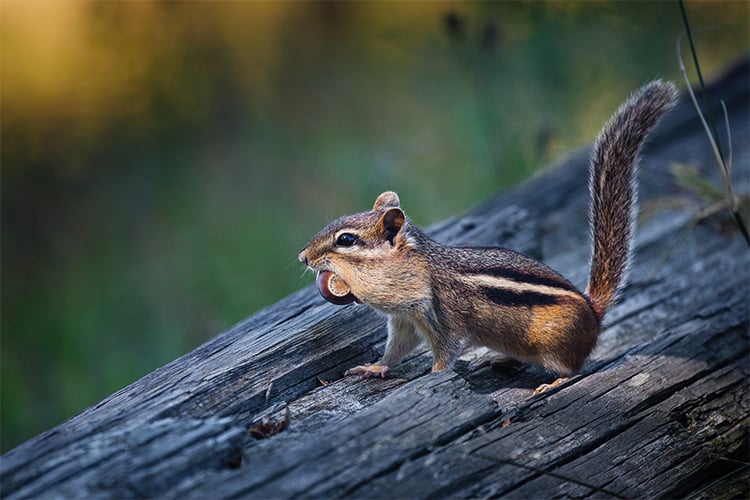
Chipmunks have short, dense fur that is reddish rust on top and buffy on the underparts. There are five black stripes on the back, one down the center and two on each flank outlining a white stripe. There is a white eyeline above and below each eye and separated by a slash of black.
With a body 5 to 6 inches long and a tail 3 to 4 inches long, chipmunks are about a third the size of the gray squirrel. As chipmunks scamper along the ground they hold their flat, hairy tail in the air.
HABITAT
Most frequently found in forests and woodlots where they forage for food in leaf litter, chipmunks are also at home in suburban yards and city parks.
BEHAVIOR
Chipmunks are diurnal. They are industrious creatures who spend their days gathering and storing food in their burrows. The food stored in their burrow will sustain them during the winter.
Chipmunks possess cheek pouches in which they store food before depositing it in their burrow. Researchers have reported watching a chipmunk stuff nearly six dozen black-oil sunflower seeds in its pouches.
BURROWS
A chipmunk's burrow system is quite amazing. They dig an entrance hole 1½ to 2 inches diameter leading to a working tunnel 10 to 30 feet deep, which they excavate through the soil.
Off the tunnel they excavate chambers for sleeping, storing food, defecating, and a nursery chamber if the burrow belongs to a female. Some observers have determined that chipmunks often store different kinds of foods in different chambers.
The nest chamber, which measures a foot across and 6-8 inches high is lined with grasses and dry leaves. This chamber is used for sleeping, giving birth and overwintering.
Once the chambers have been completed the chipmunk tunnels outward from one of the chambers, using the dirt to plug the working tunnel and making a new entrance hole. As a result, the entrance hole, which is usually located under stonewalls, fallen trees or rocks, has no mound of dirt around it to attract predators.
HIBERNATION
Chipmunks are not true hibernators, instead they enter a torpid state, in which their body temperature and heartbeat decrease, but they wake every few days to feed on stockpiled food and to defecate.
In Massachusetts, they enter their burrows in late October and, except briefly during warm spells, they do not emerge until March or April.
FOOD
Seeds, berries, nuts and fruit are the mainstay of the chipmunk's diet, but they also eat insects, insect larvae, slugs, snails, and earthworms. Occasionally they will eat birds such as sparrows, juncos, and starlings, bird's eggs, frogs, and small snakes.
MATING
Eastern chipmunks in Massachusetts usually mate twice a year, once in the early spring from March to early April and again from early June to mid-July. The female rebuffs the male after mating and he does not share in the rearing of the young.
YOUNG
A litter of two to five tiny (2.5 inch), hairless, and blind young are born after a 31 day gestation period. The first litter is generally born in April and May, and the second in July and August.
The young open their eyes at four weeks and weaning begins at this time.
At six weeks, under their mother's watchful eye, they begin to take short trips out of the burrow. After a week or two, the mother becomes more aggressive toward her offspring to prepare them for their independence.
About two weeks after they first emerge, the mother refuses to allow them to enter the burrow and the young are forced to disperse and find or dig their own burrow.
TERRITORIAL SINGING
When the young disperse in the spring and fall, adults occupying nearby burrows, give loud "chip-chip-chip" call outside the burrow entrance presumably, to notify the young of occupied territory.
SITUATIONS AND SOLUTIONS
TUNNELS UNDER PATIOS AND WALKWAYS
Chipmunks' burrows are small and rarely causing structural damage, therefore, in most cases, they can be tolerated.
CHIPMUNKS DIGGING UP FLOWER BULBS
After planting bulbs, place ½ inch mesh, chicken wire or hardware cloth flat on the ground over the bulbs. The plants will grow up through the mesh, but the chipmunks cannot penetrate it.
CHIPMUNKS IN HOMES
Chipmunks rarely enter homes intentionally, they prefer to set up housekeeping underground. But, if there is an opening which provides easy access the chipmunk may enter in search of food. Check for openings around foundations and bulkheads and seal with wood, metal or caulking.
If one is found in the house or basement, try to confine it to one location and open windows and doors with direct access to the outdoors. The chipmunk will be attracted to the light and exit the building.
The other option is to catch the chipmunk in a Hav-a-hart trap, baited with sunflower seeds and then release it outdoors. See Chipmunks And The Law.
CHIPMUNKS AND THE LAW
Relocating wildlife is illegal in Massachusetts. It is detrimental to the well-being of wildlife as well as the public. Unknowingly, sick animals may be transported and released in other locations, causing the spread of disease. Animals released in unfamiliar territory have a hard time surviving. They must compete with resident animals, and they have difficulty finding food and shelter. Furthermore, relocation is ineffective: each time a territory opens, there is always another chipmunk "waiting in the wings."
It is also against state law to possess wild birds and mammals. Wildlife rehabilitators are trained and licensed by the state to care for injured and orphaned wildlife. If you need the services of a rehabilitator contact MassWildlife (Massachusetts Division of Fisheries and Wildlife ) at 508-366-4470, or Massachusetts Audubon's Wildlife Information line at 781-259-2150.
CHIPMUNKS AND DISEASE
As with most other rodents (the exception being woodchucks), chipmunks are not
susceptible to rabies and present no real health threat to humans.
Back to top