
| Birds: Species | Owls
Although owls are among the best-known birds in folklore and literature, they remain something of a mystery to most people. It is not surprising, since they are mainly nocturnal, and by day hide in tree cavities or roost in the trees where they are hidden by dense foliage.
BEHAVIOR
Most owls tend to focus their activities under a cloak of darkness, and do not begin hunting until shortly after dark. Long-eared Owls and Short-eared Owls often begin hunting shortly before sundown, and can be seen coursing low over meadows in search of prey. During the day, most owls are likely to sleep or doze in the security of a thick evergreen or within a the cavity of a tree.
Most species are most vocal just after sundown and then again just before sunrise. However, during courtship and the early breeding season, they often can be heard throughout the night. Some species, such as Eastern Screech-Owl and Barred Owl, will vocalize during the day.
PELLETS
Owls eat their prey (largely rodents) whole, then regurgitate the indigestible fur and bones as pellets. Sometimes you can find dozens of these pellets under a single tree if a bird has a favorite roosting spot. The size of the pellets is often suggestive of the species. Finger-sized usually means a smaller owl such as Saw-whet or Screech; thumb-size is likely to be a Barred or Long-eared Owl; while Barn and Great Horned owls can cast pellets larger than golf balls.
THE BREEDING OWLS OF MASSACHUSETTS
 Barn Owl |
Barn Owl. The Barn Owl is a permanent resident on the islands of Martha's Vineyard and Nantucket, and is a rare breeder in the rest of the state. They nest largely in man-made structures, so their preference for hunting in large fields makes barns the ideal nesting site.During the winter, they will sometimes stray from their breeding grounds, and can be discovered roosting in a conifer grove along the coast. In Massachusetts, their blood-chilling, rasping calls are seldom heard except near their nests.
Eastern Screech-Owl. The Screech-Owl is the most common owl in Massachusetts and a permanent resident throughout the state, except in the high hill-country areas of western Massachusetts. They customarily nest in tree cavities, but will readily accept a man-made nesting box. Screech-Owls are most vocal from April to September, and their eerie, whistling "whinny" can be heard at night almost anywhere. Prime breeding habitat seems to be secondary woodlots and their edges, orchards, and well-planted city parks.
Great Horned Owl. The Great Horned Owl is our largest and our second most common owl. Its deep, mellow, hooting calls are typical sounds of winter nights in much of rural Massachusetts. The Great Horned Owl nests very early, usually by late February. Its nest is generally a modified crow or Red-tailed Hawk nest, although they will sometimes select an old Great Blue Heron nest, and coexist seemingly peacefully among the colonial-nesting herons.
 Barred Owl, photo by Joe Vincent |
Barred Owl. The Barred Owl is an uncommon permanent resident in moist woodlands, and is a local breeding bird in much of Massachusetts, except along the southeastern coastal plan and on Cape Cod, where it is absent.Its resonant "who cooks for you?" call is most frequently heard from April until late summer, not just at night, but occasionally during daylight hours as well. Its nest site is generally in a large tree cavity or an old crow or hawk nest. Barred Owls show a strong attachment for a breeding location and will often use the same nest for several years in succession.
Long-eared Owl. The Long-eared Owl is perhaps the least common of Massachusetts' breeding owls. It is almost completely nocturnal, and also is much less vocal than many other owl species. Most observers know it best by its occasional gatherings at communal winter roosts. Documented nesting records suggest that this species likes open country with scattered thickets, groves, or woodlots for breeding. Nests are generally in pines and are usually modified crow nests. The vocalizations of this species are varied; however, almost all seem to be used chiefly at or near the nest. It is likely that certain of the less common calls of other owl species are often erroneously attributed to this species.
Short-eared Owl. The Short-eared Owl is best known as a migrant and winter species. It is partial to broad, coastal salt marshes or fields near the seashore. It is partly diurnal or crepuscular and can sometimes be seen coursing low over open country like a Northern Harrier. As a breeder, it is found on most of the large outer islands such as Nantucket, Martha's Vineyard, and Monomoy, but it is rare as a nesting bird on the mainland. It nests on the ground in open or semi-open moorland habitat. It is usually silent.
 Northern Saw-whet Owl, photo by Paul Higgins |
Northern Saw-whet Owl. Although the little Saw-whet Owl is best known as a late fall migrant or as a winter visitor, it is also an occasional breeder throughout much of Massachusetts. Often the best indication of its presence in an area is its mellow "too-too-too-too" call at dusk on warm early spring evenings. It is probably a permanent resident on Cape Cod, but it has been found nesting in a variety of locations throughout Massachusetts. Saw-whets are cavity nesters, and will use old woodpecker holes or bird boxes as well as natural cavities.
BRANCHING
Occasionally one comes across an apparently helpless young owl, most often in spring or early summer. When young owls leave the nest, their first exploration is usually on foot, hopping and climbing from branch to branch, and flapping their wings to strengthen them for flight later on. Falconers call this activity "branching." Due to their inexperience, the young owls sometimes end up on the ground.
In most cases when a young owl falls to the ground, no action needs to taken, because the parent owls will continue to bring food until the young bird is able to fly to safety. If the bird is in imminent danger (for example, of being attacked by a dog), you can place the bird in a basket or other open container and secure it in a nearby tree (preferably the nest tree), out of the reach of predators. If you attempt such a rescue, wear thick gloves and hold the bird well away from your face. If you are not comfortable handling the bird, call Massachusetts Audubon's Helpline at 781-259-9506 ext. 7416 for advice, or call the Massachusetts Division of Fisheries and Wildlife Environmental Police, at 1-800-632-8075, and they will dispatch an officer to the site to assist with the rescue if it is deemed necessary. If the owl is injured, place it in a box with a cover, and call one of the numbers given above.
LOCATING OWLS
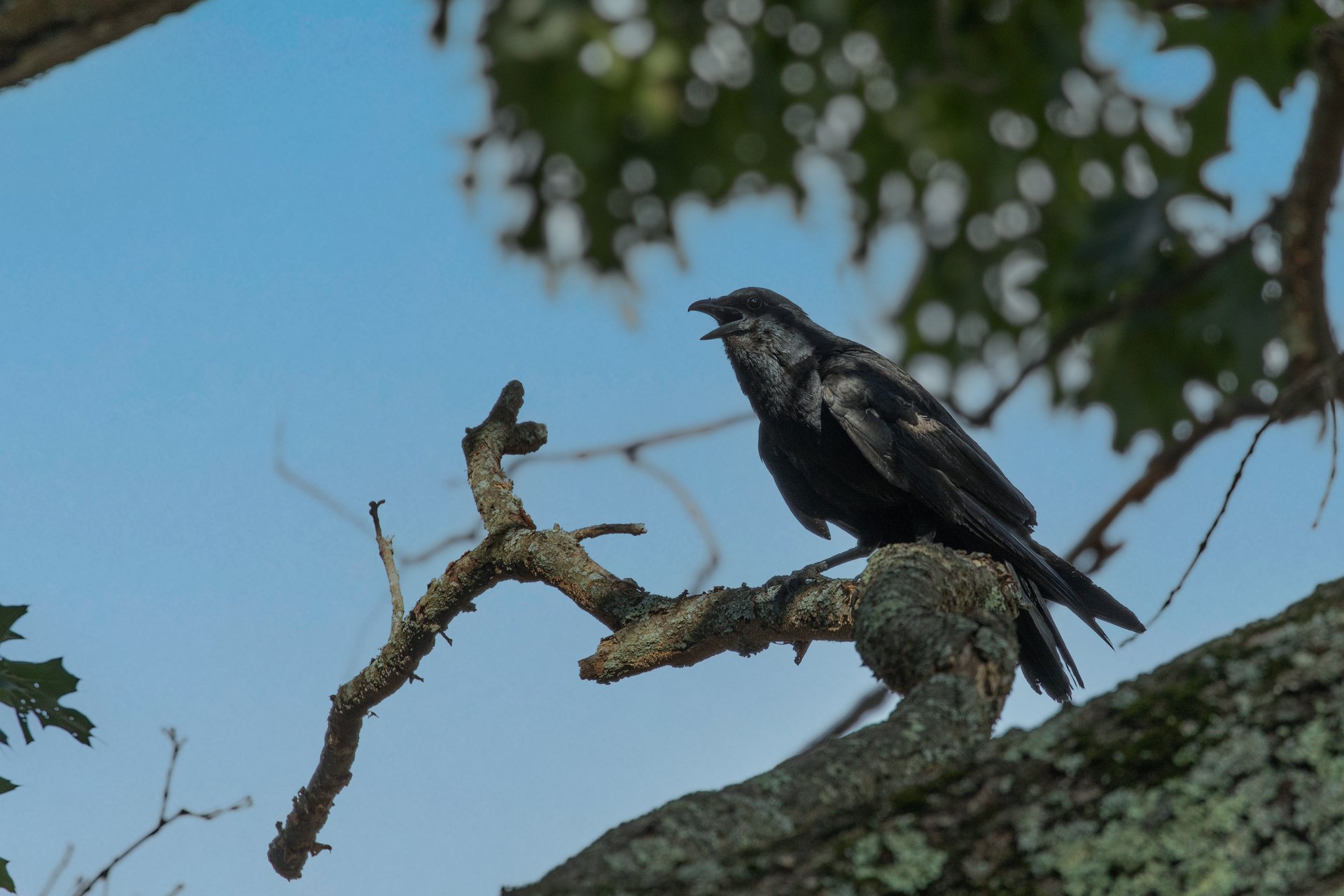
Crows, Blue Jays, and other songbirds can sometimes lead one to a roosting owl. The instinct among these birds to draw attention to predators by harassing it while making loud alarm calls is known as "mobbing." If a quiet approach is made, good views of the "mobbed" owl may be obtained.
Many owls will use the same roost tree for several days, and evidence of this can be found in "whitewash" on branches and on the ground, and owl pellets (the regurgitated fur and bones of its prey).
Perhaps one of the best ways to locate owls is to join an organized owling excursion. Many of Massachusetts Audubon Society's sanctuaries offer these programs, so call your local sanctuary for additional details.
Back to top